
Korea’s green transport transformation,we supply the GX infrastructure.




Plug it in,
and measurement begins.
It connects straight to the OBD-II port (some vehicles may require additional wiring). From the moment the engine starts, it reads driving, fuel, idling, and emissions every second and streams them to the cloud. Not an estimate — data the vehicle actually produced.
From measurement to assets. One company.
From measurement hardware to calculation, reporting, integration, and assetization — when each step changes hands, accountability for the data breaks. One company holds all four.
In one trip, only the paid legs become the shipper’s carbon.
Carbon DTG and the SaaS precisely identify the paid-transport legs of a trip. Only the legs carrying a shipper’s cargo are attributed to that shipper’s Scope 3 (Cat 4/9); empty legs are excluded from shipper emissions — exactly the measured approach the GHG Protocol revision is heading toward.
Empty legs are not the shipper's emissions — only measured paid legs are attributed to that shipper's Scope 3.
Measure precisely,
and your customers’ emissions go down.
Estimation factors are set conservatively high, by design. Measure revenue transport legs second by second and the overstatement disappears — the emissions reported to shippers and prime contractors are corrected to actual values, and their Scope 3 shrinks.
The emissions of the transport service the shipper purchased are reported as measured — not estimated — so the shipper’s Scope 3 is corrected down to actual values.
Even when most transport is carried out by agents, subcontractors, and owner-operators, measuring and reporting the paid transport legs reduces the prime contractor’s Scope 3.
Carbon disclosure is done previewing.
Disclosure mandates follow the calendar — but overseas shippers move faster, and their demands have already landed in your tenders and contracts.
Over 20 jurisdictions are adopting the ISSB standards (IFRS S2), and shippers’ carbon-data requirements are turning into contract and tender conditions.
The definitive CBAM regime started January 2026; the first certificate settlement lands by September 2027. Embedded-carbon data now travels with the cargo.
Companies over $1B doing business in California report Scope 1·2 from August 2026, with Scope 3 following in 2027 — transport data lands in customers’ disclosures.
Under the 2025 Omnibus, wave-2 and wave-3 CSRD reporting begins in 2028–2029 — the disclosure net keeps widening across supply chains.
Before the regulation arrives, your shippers’ demands already have.
The standard shift — GHG Protocol revision →Measurements become reports.
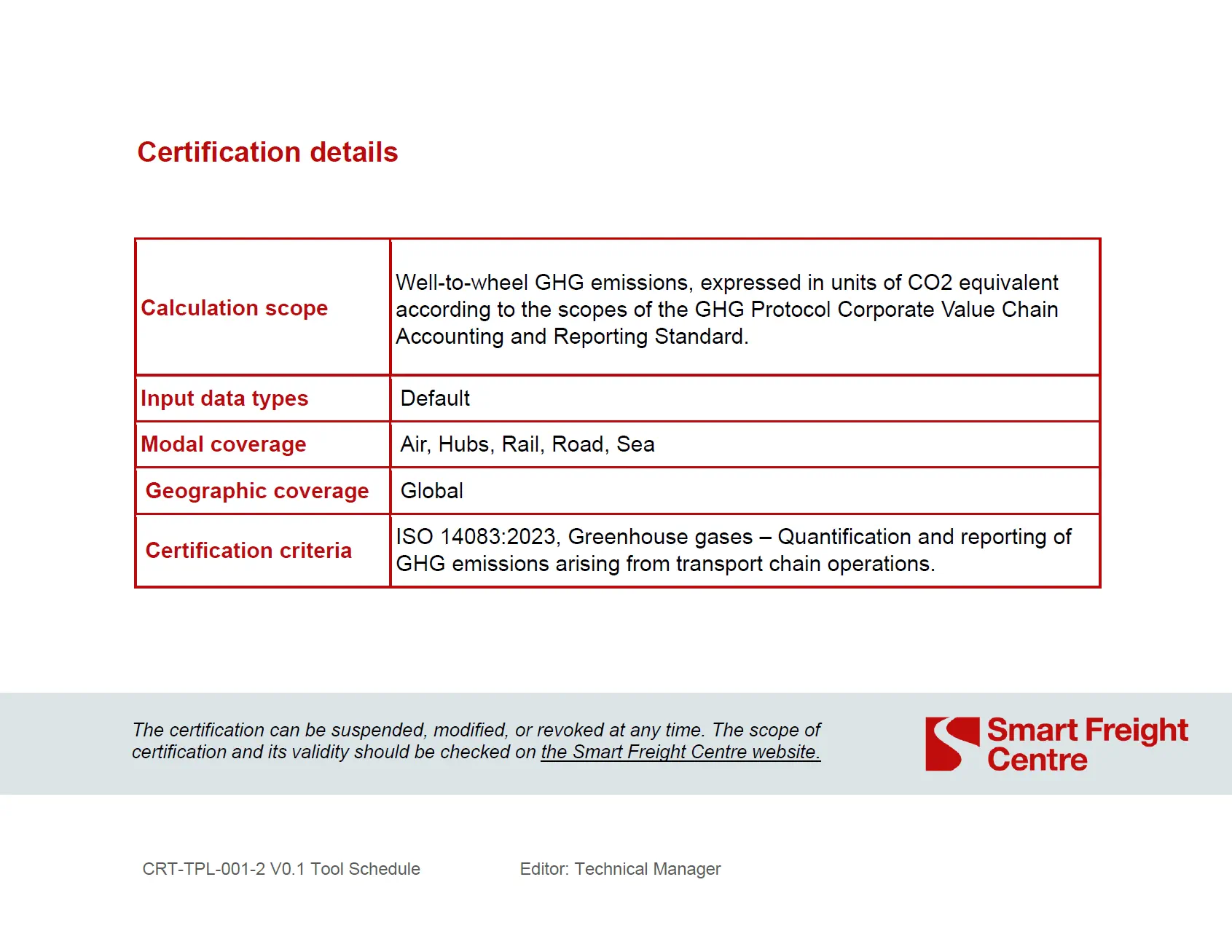
Every second of DTG data is calculated under ISO 14083 and auto-published on the 1st of each month, formatted for CSRD, ISSB, and CDP.
HQ Supply-chain Carbon Analysis
| Group | Total (tCO₂e) | Wtd. EI (gCO₂e/tkm) | Count |
|---|---|---|---|
| Road | 12.34 | 68.5 | 128 |
| Sea | 45.67 | 9.2 | 34 |
| Rail | 3.21 | 24.1 | 12 |
| Air | 8.90 | 610.3 | 6 |
A preview reproducing the actual product screen’s structure and labels. All figures are illustrative.
Supply-chain emissions headline · Σ own (exclusive split)
Tiered supply chain · own / subtree
- Prime HQ (example)reporting rootown 0
- Agency A (example)subtree 650150
- Subcontractor B (example)leaf · dedup✓500
Emission-intensity trend · gCO₂e/tkm
Agentic processing · live
Supply-chain alert stream
2s ago · execution-sealed
18s ago · includes AI estimate
1m ago · n/a ≠ 0
A structural mirror of the real LCS Cloud screen · all figures and company names are examples · data contract = disclosure engine shape (own/subtree · Σown) · motion = CSS/animated-SVG
Certificates as proof.
Original documents issued by independent bodies · not our own numbers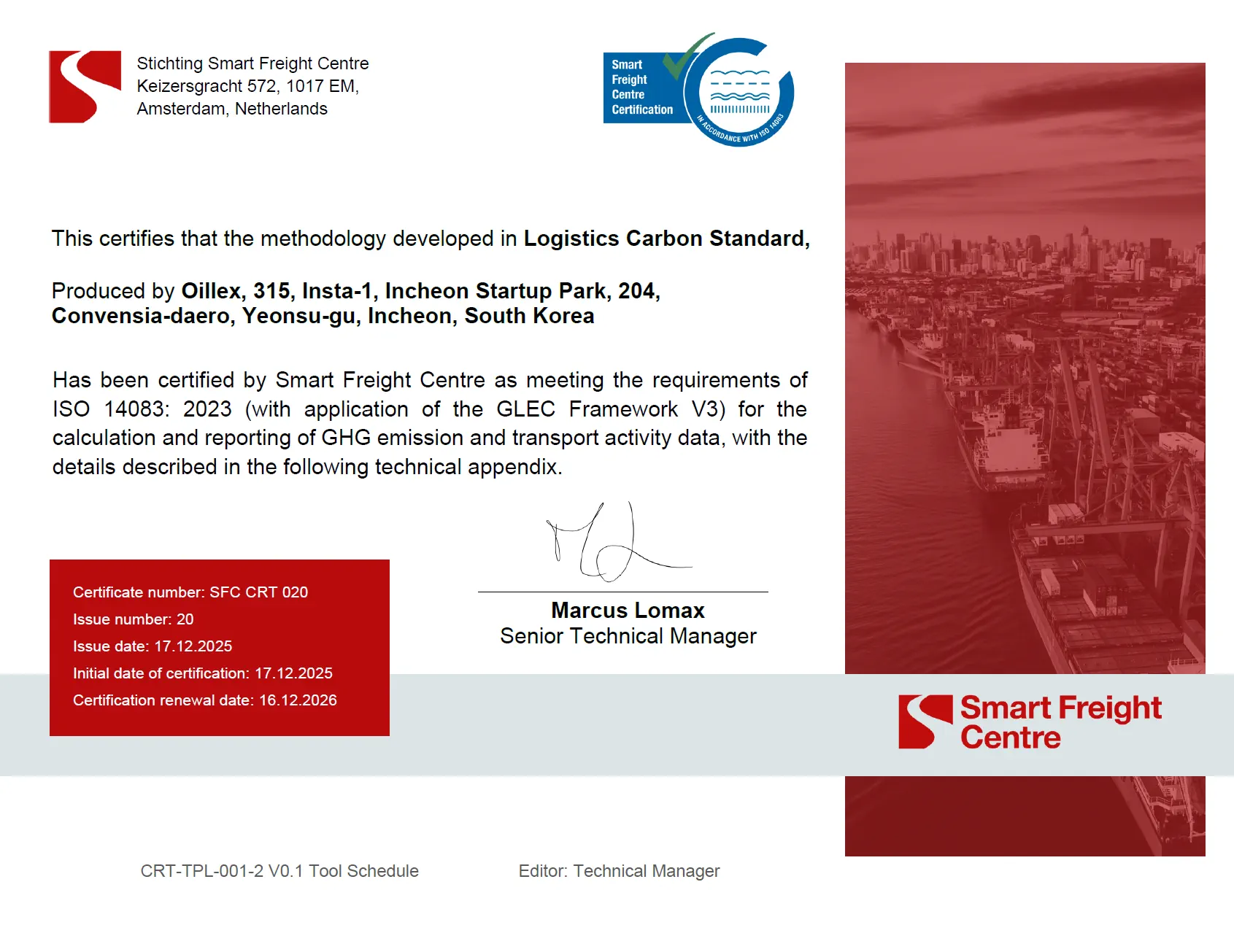


It starts with
measurement.
We review your current reporting setup and design a rollout sequence that fits your fleet.
Book a 30-min assessment →